“Doctor, I have tried painkillers, ointments, belts, and even bed rest — but the pain keeps coming back.” If I had to pick the single most common sentence I hear from new patients at our Vastrapur clinic, this would be it.
Here is the honest truth: painkillers mask pain, they do not fix its cause. Rest reduces irritation temporarily, but a stiff joint stays stiff and a weak muscle stays weak. This is exactly where manual therapy comes in — one of the most trusted, research-backed treatment approaches in modern physiotherapy, and one of the core specialities we practice at Reboot Physiotherapy and Fitness Clinic in Ahmedabad.
In this article, I will walk you through what manual therapy actually is, the techniques we use, which conditions respond best to it, and what your first session with us will look like.
What Is Manual Therapy?
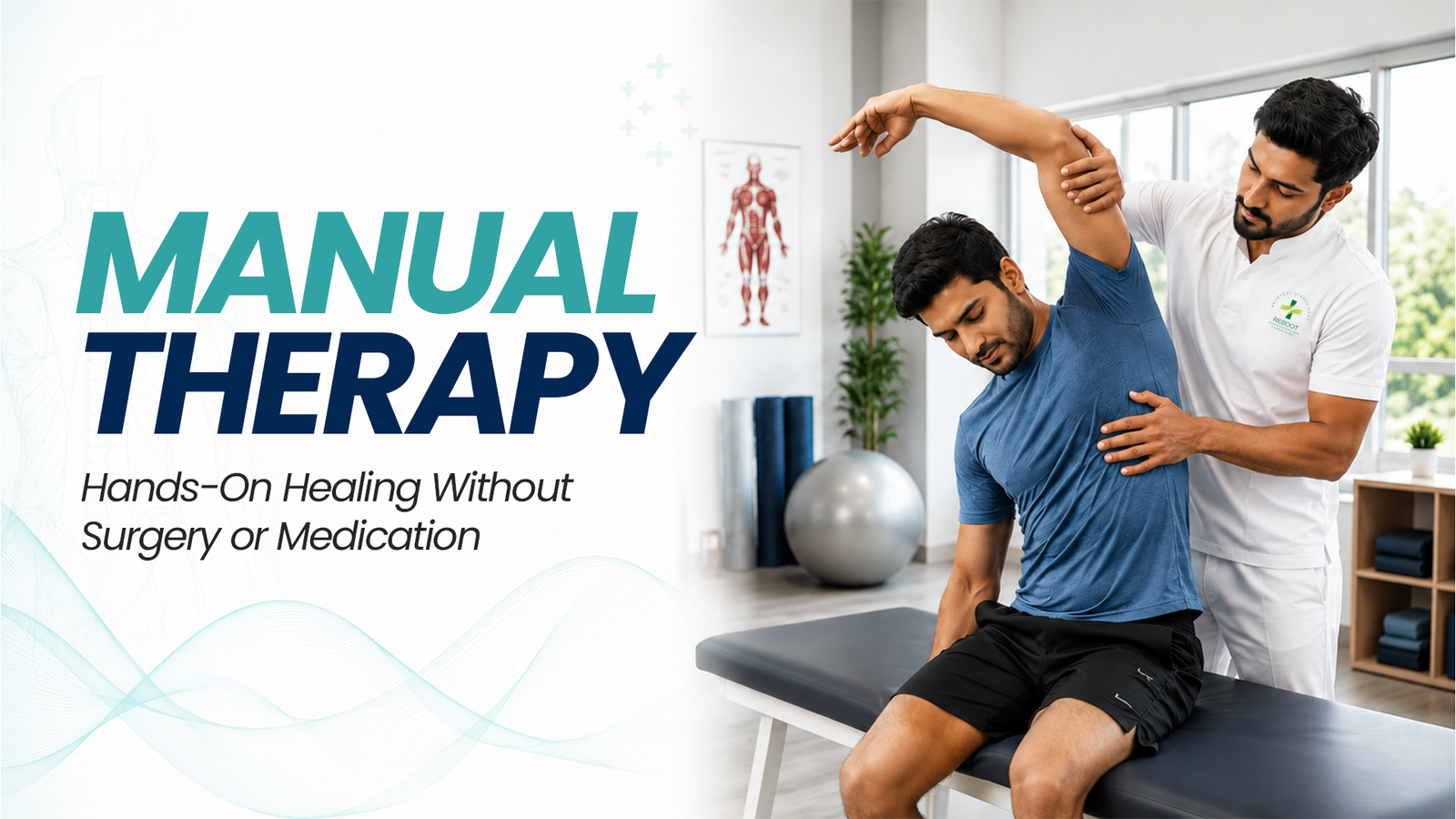
Manual therapy is a specialized, hands-on treatment approach in which a trained physiotherapist uses precise, skilled movements of the hands to assess and treat joints, muscles, and soft tissues. There are no machines, no medicines, and no surgery involved — the therapist’s hands are the treatment tool.
But do not mistake it for a massage. While a massage generally works on relaxing surface muscles, manual therapy is a clinical treatment based on a detailed assessment of your joint mechanics, muscle function, and movement patterns. Every technique is chosen for a specific therapeutic reason — to restore movement in a stiff joint, release a tight muscle, reduce nerve irritation, or correct faulty movement.
Key Manual Therapy Techniques We Use at Reboot
- Joint mobilization — gentle, rhythmic gliding movements applied to a stiff joint to restore its natural range of motion. Highly effective for frozen shoulder, stiff knees, and spinal stiffness.
- Joint manipulation — a quick, controlled, high-velocity technique used on specific joints to instantly reduce stiffness and pain, performed only after careful assessment.
- Soft tissue mobilization — targeted deep-tissue work on muscles, tendons, and fascia to release knots, adhesions, and scar tissue.
- Myofascial release — slow, sustained pressure that releases the connective tissue layer responsible for chronic tightness and postural pain.
- Muscle energy techniques (MET) — the patient actively participates by contracting specific muscles against gentle resistance, resetting muscle length and joint position.
- Neural mobilization — carefully gliding irritated nerves (like in sciatica or cervical radiculopathy) to reduce nerve-related pain, tingling, and numbness.
How Manual Therapy Works on Your Body
When a joint becomes stiff — whether from injury, aging, poor posture, or prolonged sitting — the tissues around it shorten and thicken, and the joint gradually loses its natural glide. The body then compensates: other joints and muscles take on extra load, and that is when secondary pains begin. A stiff hip creates knee pain. A stiff mid-back creates neck pain. This chain reaction is why treating only the spot that hurts often fails.
Manual therapy breaks this cycle at its source. Skilled hands-on techniques restore the joint’s natural movement, relax overprotective muscles, improve local blood flow, and calm down sensitized nerves. Research consistently shows that manual therapy combined with exercise delivers better and longer-lasting results than either treatment alone — which is exactly the model we follow at Reboot.
Conditions That Respond Exceptionally Well to Manual Therapy
- Chronic neck pain and cervical stiffness — including tech-neck from long screen hours
- Lower back pain and lumbar spondylosis
- Frozen shoulder (adhesive capsulitis) — one of the most common conditions we treat in Ahmedabad
- Sciatica and nerve-related leg pain
- Knee stiffness and early osteoarthritis
- Tension headaches originating from the neck
- Sports injuries — sprains, strains, and post-injury stiffness
- Post-fracture or post-surgery joint stiffness (after medical clearance)
If your pain has lasted more than two to three weeks, keeps returning after rest, or is slowly limiting your daily activities — climbing stairs, turning your neck while driving, reaching overhead — manual therapy assessment should be your next step.
Why Choose Manual Therapy Over Medicines or Surgery?
Let me be clear — medicines and surgery absolutely have their place in healthcare. But for a very large percentage of musculoskeletal problems, they are simply not the first answer. Painkillers taken for months harm your stomach, kidneys, and liver, while doing nothing to restore joint movement. And surgery should always be the last resort, not the first.
Manual therapy offers a middle path that most patients in Ahmedabad do not know exists: a treatment that is drug-free, non-invasive, evidence-based, and targets the actual mechanical cause of your pain. Many of our patients who were told “you will have to live with this pain” or were heading toward unnecessary procedures have returned to completely normal, active lives after a structured course of manual therapy and exercise.
What to Expect in Your First Manual Therapy Session at Reboot
Your first visit begins with a detailed one-on-one assessment — we examine your posture, joint movements, muscle strength, and movement patterns, and we listen carefully to your history. Based on this, we identify the true source of your pain, which is often not where the pain is felt.
Treatment then begins in the same session. You will feel firm but controlled pressure and stretching — most techniques are comfortable, and many patients feel a noticeable improvement in movement before they leave the clinic. We finish by teaching you two or three specific exercises to maintain the gains at home. A typical treatment plan runs between six and twelve sessions depending on how long-standing your condition is.
Is Manual Therapy Safe?
In the hands of a qualified physiotherapist, manual therapy is extremely safe. Every technique we apply follows a thorough assessment and screening process. We modify or avoid certain techniques for patients with osteoporosis, recent fractures, inflammatory arthritis flare-ups, or specific medical conditions — which is precisely why manual therapy must be taken from a certified professional, never from an untrained masseur or bone-setter.
Frequently Asked Questions
1. Is manual therapy painful?
Most techniques are comfortable and many are deeply relieving. Some deep tissue work may cause mild, temporary soreness — similar to post-workout soreness — that settles within 24 to 48 hours.
2. How is manual therapy different from a massage or bone-setting?
Massage relaxes surface muscles without clinical assessment. Traditional bone-setting is not evidence-based and can be dangerous. Manual therapy is a scientific, assessment-driven treatment performed by a qualified physiotherapist, targeting the specific joint or tissue causing your problem.
3. How many sessions of manual therapy will I need?
Recent problems often improve within 4 to 6 sessions. Chronic, long-standing conditions typically need 8 to 12 sessions combined with a home exercise program. You should feel measurable improvement within the first 2 to 3 sessions.
4. Can manual therapy help me avoid surgery?
In many musculoskeletal conditions — such as early arthritis, disc-related back pain, and frozen shoulder — a structured course of manual therapy and exercise significantly improves pain and function, and many patients avoid surgery altogether. However, every case is unique and requires proper assessment first.
5. What is the cost of manual therapy in Ahmedabad?
Cost varies based on your condition and treatment plan. Message us on WhatsApp and our team will guide you on consultation charges and honest treatment estimates — no unnecessary packages, only what your condition actually needs.